Modern kitchens demand appliances that do more than just keep food cold, they need to save energy, run quietly, and last longer. LG’s Smart Inverter refrigerators deliver on all three fronts by using variable-speed compressor technology that adjusts cooling power based on actual demand. Unlike traditional single-speed compressors that cycle on and off, inverter systems ramp up or down smoothly, cutting energy waste and reducing wear on components. For homeowners looking to upgrade aging appliances or build out a new kitchen, understanding how Smart Inverter tech stacks up against conventional models can mean the difference between a refrigerator that hums along for fifteen years and one that’s rattling and running up your electric bill in five.
Table of Contents
ToggleKey Takeaways
- LG Smart Inverter refrigerators use variable-speed compressor technology that reduces energy consumption by 25–35% compared to traditional models, saving homeowners $30–$40 annually or $500–$600 over a 15-year lifespan.
- The Smart Inverter compressor operates at low speeds almost continuously, producing quieter performance (24–30 dB) and extending component lifespan with 30–40% lower failure rates in the first decade.
- LG backs its Linear Compressor design with a 10-year warranty, significantly longer than competitor offerings of 1–5 years, protecting against expensive out-of-warranty repairs that can cost $600–$800.
- Key features like Door-in-Door compartments, Multi-Air Flow systems, and InstaView panels complement inverter efficiency by reducing unnecessary door openings and maintaining stable temperatures.
- Proper installation—including leveling, maintaining ventilation clearance (1 inch on sides, 2 inches at back), and connecting to the ThinQ app—maximizes the Smart Inverter refrigerator’s efficiency and long-term performance.
What Is an LG Smart Inverter Refrigerator?
An LG Smart Inverter refrigerator uses a variable-speed Linear Compressor instead of the conventional fixed-speed reciprocating compressor found in older units. The compressor is the heart of any refrigerator, it circulates refrigerant through coils to remove heat from the interior. Traditional compressors operate at a single speed, turning fully on when the temperature rises above the setpoint and shutting off once it drops below. That stop-start cycle wastes energy and creates temperature swings.
Inverter technology changes the game. The Smart Inverter compressor can run at variable speeds, anywhere from 20% to 100% capacity, so it modulates cooling output to match real-time demand. If you’ve just loaded groceries, it ramps up. During overnight hours when the door stays closed, it dials back. This continuous, low-speed operation keeps internal temperatures more stable and consumes less power overall.
LG’s Linear Compressor design also reduces the number of moving parts by using a piston-driven linear motion instead of a rotating crankshaft. Fewer friction points mean less mechanical noise and lower failure rates. LG backs this with a 10-year parts warranty on the compressor in most models, a signal of confidence in long-term durability.
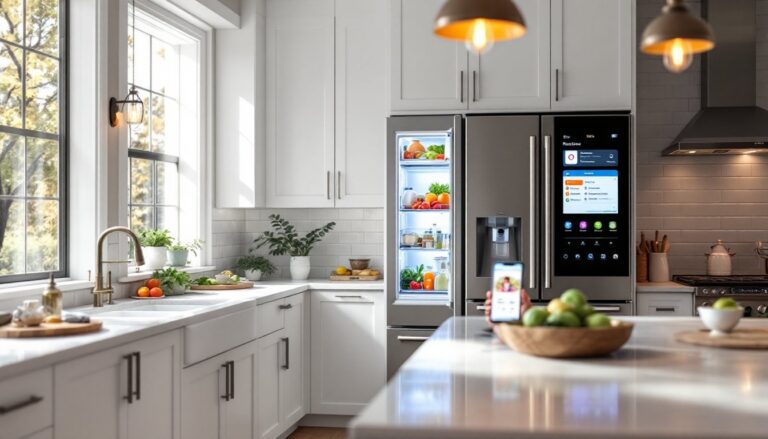
Many LG Smart Inverter models also integrate Wi-Fi connectivity and LG’s ThinQ app, letting homeowners monitor internal temps, adjust settings, and receive maintenance alerts from a smartphone. That “smart” label isn’t just marketing, it refers to both the inverter’s adaptive logic and the appliance’s IoT capabilities.
Key Benefits of LG Smart Inverter Technology
Energy Efficiency and Cost Savings
Smart Inverter compressors can reduce energy consumption by 25–35% compared to non-inverter models, depending on usage patterns and ambient temperature. The U.S. Department of Energy estimates that refrigerators account for roughly 13% of a household’s total electricity use, so a quarter-ton reduction in annual kilowatt-hours adds up fast.
Most LG Smart Inverter units carry an ENERGY STAR certification, meaning they meet or exceed federal efficiency guidelines. In practical terms, a mid-size French-door inverter model might draw 450–500 kWh per year, versus 650–700 kWh for an equivalent non-inverter unit. At the national average of $0.16 per kWh (as of 2026), that’s a savings of roughly $30–$40 annually. Over a 15-year lifespan, the total savings approach $500–$600, enough to offset part of the initial premium.
Because the compressor runs at lower speeds most of the time, it also generates less waste heat. That can be a small but welcome bonus in warmer climates, where every BTU of heat dumped into the kitchen raises the load on the air conditioner. Many experts evaluating refrigerator efficiency and performance highlight inverter models for their real-world energy savings.
Quieter Operation and Longer Lifespan
Traditional compressors announce themselves every time they kick on, a sudden hum or rattle that can be jarring in an open-concept kitchen or during nighttime hours. Smart Inverter compressors, by contrast, operate almost continuously at low speed, producing a near-constant, barely audible hum. LG rates most Linear Compressor models at 24–30 dB during steady-state operation, quieter than a whisper.
The reduced start-stop cycling also extends component life. Every time a conventional compressor kicks on, there’s a surge of electrical current and mechanical stress. Over years, those cycles fatigue windings, bearings, and seals. Inverter compressors spread that workload smoothly, lowering peak stress and heat buildup. Field data from appliance service networks show that inverter-equipped refrigerators have failure rates 30–40% lower in the first decade compared to non-inverter peers.
LG’s 10-year warranty on the Linear Compressor reflects this reliability advantage. Most competitors offer only 1–5 years on the compressor, leaving homeowners exposed to expensive out-of-warranty repairs. If a compressor fails after year six, replacement parts and labor can easily run $600–$800, sometimes enough to justify buying a new unit. LG’s extended coverage mitigates that risk and signals long-term cost of ownership advantages.
Top Features to Look for in LG Smart Inverter Refrigerators
Door-in-Door compartments are a signature LG feature: a secondary door within the main refrigerator door that opens to reveal a narrow bin for frequently accessed items, milk, juice, condiments. Opening the Door-in-Door exposes only a small section to room air, minimizing temperature loss and compressor workload. It’s practical for busy households and pairs well with inverter efficiency.
Multi-Air Flow systems distribute chilled air through multiple vents instead of a single duct. This keeps temperatures uniform from top shelf to crisper drawer and reduces the inverter compressor’s need to spike output when you open the door. Look for models with at least four air vents spread across compartments.
SmartDiagnosis™ uses the ThinQ app and the refrigerator’s internal sensors to run diagnostics. If the unit detects a fault, blocked vent, door-seal leak, defrost-cycle anomaly, it sends an alert with a preliminary diagnosis. That can save a service call or at least arm you with information before the technician arrives. Some models even transmit diagnostic tones over the phone to LG’s support line, which decodes error codes in real time.
InstaView panels let you knock twice on a tinted glass section of the door to illuminate the interior without opening it. It’s gimmicky at first glance, but in practice it reduces unnecessary door openings, which helps the inverter compressor maintain stable temps. Think of it as a window into your fridge, useful when you’re deciding whether to restock or checking if the kids finished the OJ.
Craft Ice makers produce slow-melting, 2-inch round ice spheres for cocktails and chilled beverages. Not every model includes this, but if you entertain or appreciate a good Old Fashioned, it’s a differentiator. Standard cube and crushed-ice dispensers are common across the lineup.
Dual evaporators (found in higher-end models) separate the cooling systems for the fridge and freezer compartments. This prevents odor transfer, your ice cream won’t taste like last night’s garlic, and lets each zone maintain optimal humidity. The inverter compressor works with both evaporators, but the independent loops give finer control. Designers focused on kitchen appliance layouts and functionality often recommend dual-evaporator units for serious home cooks.
How to Choose the Right LG Smart Inverter Model for Your Home
Start by measuring the space. Standard North American refrigerator cutouts are 36 inches wide, but French-door and side-by-side models can range from 33 to 42 inches. Measure height and depth, too, some counter-depth models sacrifice a few cubic feet of capacity to sit flush with cabinetry, a trade-off that matters in galley kitchens or open layouts where the fridge is on display.
Capacity is rated in cubic feet. A family of four typically needs 20–25 cu. ft., while couples or small households can get by with 16–18 cu. ft. Larger families or anyone who meal-preps in bulk should look at 25–30 cu. ft. French-door models. Remember that usable capacity is less than gross capacity once you account for shelves, bins, and ice makers.
Decide on configuration: French-door, side-by-side, top-freezer, or bottom-freezer. French-door units (two doors on top, freezer drawer below) dominate the premium segment and pair well with inverter tech because the split doors reduce cold-air loss. Side-by-sides offer easier access to frozen goods but tend to have narrower shelves. Top-freezers are budget-friendly and efficient but lack the features and aesthetics of French-door designs. Bottom-freezers put fresh food at eye level, a nice ergonomic touch.
Check the Energy Guide label for estimated annual kWh and operating cost. Compare models within the same size class, an 18 cu. ft. top-freezer will always use less power than a 28 cu. ft. French-door, but that doesn’t mean the smaller unit is more efficient per cubic foot. ENERGY STAR certification is table stakes: look for models in the top quartile of efficiency within their class.
Budget for installation and delivery. Most retailers charge $50–$150 for delivery and haul-away of your old unit. If your kitchen requires a water-line hookup for the ice maker (common in new builds), factor in $100–$200 for a licensed plumber unless you’re comfortable sweating copper or running PEX yourself. Some jurisdictions require a permit for new water-line runs: check with your local building department.
Finally, consider finish and hardware. Stainless steel resists fingerprints better with LG’s PrintProof™ coating, but black stainless and matte finishes are trending in 2026 and hide smudges even better. Make sure handles and hinge orientation match your kitchen flow, some models offer reversible doors, others don’t.
Installation and Setup Tips for Homeowners
Clear the path before delivery day. Measure doorways, hallways, and any turns, refrigerators are bulky, and a 36-inch-wide unit needs at least a 37-inch opening when you account for packaging and maneuvering. Remove door handles or swing the fridge doors off their hinges if clearance is tight. Most LG models ship with removable handles for this reason.
Level the unit after positioning. Adjustable front leveling legs let you raise or lower each corner: use a bubble level across the top front edge and aim for dead-level or a very slight backward tilt (no more than 1/8 inch over the depth). A backward tilt helps doors self-close and prevents puddles from migrating forward. If the floor slopes, shim the low side with metal or composite shims, never wood, which compresses over time.
Leave clearance for ventilation. LG specifies 1 inch on each side and 2 inches at the back for airflow around the condenser coils. Counter-depth models often have coils on top or bottom, so check the installation manual. Blocking airflow forces the inverter compressor to work harder, negating efficiency gains and shortening lifespan.
If you’re hooking up the ice maker and water dispenser, use a 1/4-inch OD compression fitting to tap into a nearby cold-water line. Braided stainless-steel supply lines are more reliable than plastic or copper tubing. Turn off the main water supply, drill a saddle valve or install a tee fitting, then run the line to the fridge. Open the valve slowly and check for leaks before pushing the unit into place. Some codes prohibit saddle valves, check local plumbing regulations or call a pro if you’re unsure.
Let the refrigerator stand upright for at least four hours before plugging it in if it was transported on its side. This allows compressor oil to settle back into the crankcase. Powering up too soon can starve the compressor of lubricant and cause premature failure, inverter or not.
Once powered, set initial temperatures to 37°F for the fridge and 0°F for the freezer. The inverter compressor will ramp up to pull down temps over the first 24 hours. Avoid loading perishables until internal temps stabilize, use a standalone thermometer to verify, since digital displays can lag actual temps during initial cooldown.
Download the LG ThinQ app and connect the refrigerator to your home Wi-Fi. You’ll need your router’s SSID and password. The app walks you through pairing and lets you enable Smart Diagnosis, monitor energy use, and adjust settings remotely. Some models support voice control via Google Assistant or Amazon Alexa, handy for changing ice-cube size or activating Express Freeze without opening the door.
Finally, register your appliance with LG within 30 days of purchase to activate the full warranty, including the 10-year compressor coverage. Keep your receipt and model/serial numbers on file. If you’re remodeling or swapping out cabinetry down the line, enthusiasts on design and remodeling forums often share tips for integrating new appliances into updated kitchen layouts without costly modifications.
Smart Inverter refrigerators aren’t plug-and-forget, they reward proper installation and setup with years of quiet, efficient service. Take the time to level, vent, and configure correctly, and the inverter compressor will do the rest.